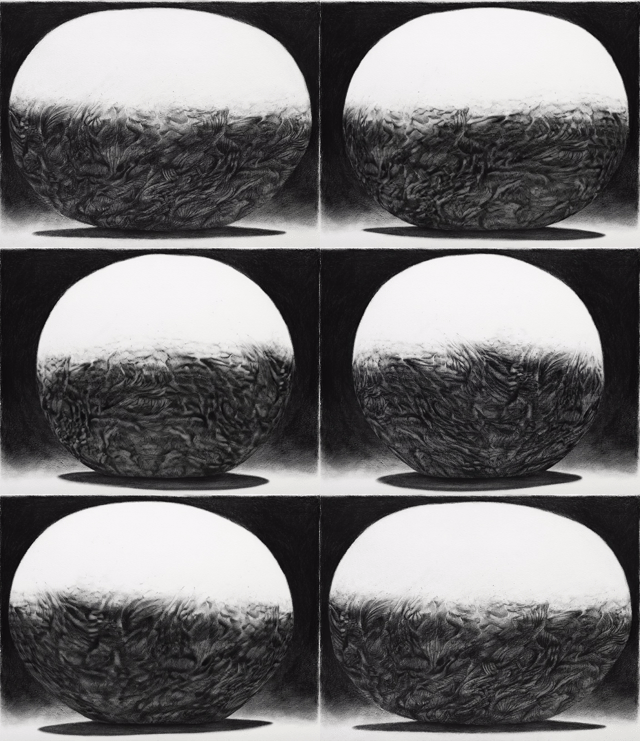

The first person to discover the object was not an astronaut, a physicist, or a military officer, but a fisherman named Elias Moreau who spent his life navigating the cold Atlantic waters near the coast of Brittany. During the coldest spring Europe had experienced in nearly a century, Elias noticed something enormous drifting silently through the morning fog several kilometers from his boat. At first he believed it was the remains of a capsized vessel, but as he approached, he realized the object was perfectly smooth and strangely luminous beneath the gray light of dawn. It floated without sinking despite its immense size, and pale silver veins pulsed slowly beneath its white surface like distant lightning trapped beneath ice. The sea around it had become unnaturally calm, and even the gulls had disappeared from the sky.
Elias radioed the coast guard immediately, although he struggled to explain what he had found because the object resembled nothing ever built by human hands. Within hours military ships surrounded the area while satellites belonging to dozens of nations redirected themselves toward the Atlantic coast. News channels interrupted normal programming, and before the day had ended the mysterious object had already acquired a name repeated endlessly across television screens and social media feeds around the world: The Egg from Outer Space. Scientists, intelligence agencies, and political leaders denied any involvement, which only intensified public fascination and fear. By the following morning the egg had been transported under heavy security to a temporary international research facility constructed outside Brest, where armed guards protected it behind layers of reinforced steel and concrete.
The egg resisted every scientific examination performed during the following week. Laser drills shattered against its shell, thermal scanners returned contradictory information, and electromagnetic analysis produced results that defied established physics. The outer surface appeared colder than deep space itself while the interior emitted a faint biological warmth comparable to the temperature of a living organism. More disturbing still were the psychological effects reported by researchers working near the object. Several technicians claimed to hear whispers in forgotten childhood languages, while others experienced vivid hallucinations involving dead relatives or memories that did not belong to them. Computers malfunctioned continuously inside the research complex, displaying symbols from unknown alphabets or generating fragments of impossible equations before shutting down entirely. One military supercomputer produced a single sentence moments before losing power forever: IT IS WAITING.
Professor Hana Okafor, one of the world’s leading exobiologists, was appointed director of the investigation because unlike many officials she refused to approach the phenomenon as a potential weapon. Hana believed hostility usually revealed itself through violence or intimidation, whereas the egg radiated something far stranger and far more unsettling: patience. She spent long hours alone inside the observation chamber studying the smooth white shell beneath sterile laboratory lights while political tensions escalated outside the facility. Governments argued over ownership of the discovery, religious movements proclaimed the beginning of a new era, and financial markets collapsed under the pressure of global panic. Despite international pressure demanding immediate answers, Hana admitted privately that the egg did not resemble technology at all. Instead, it seemed almost biological, as if it had grown somewhere unimaginably distant before drifting patiently across interstellar darkness toward Earth.